
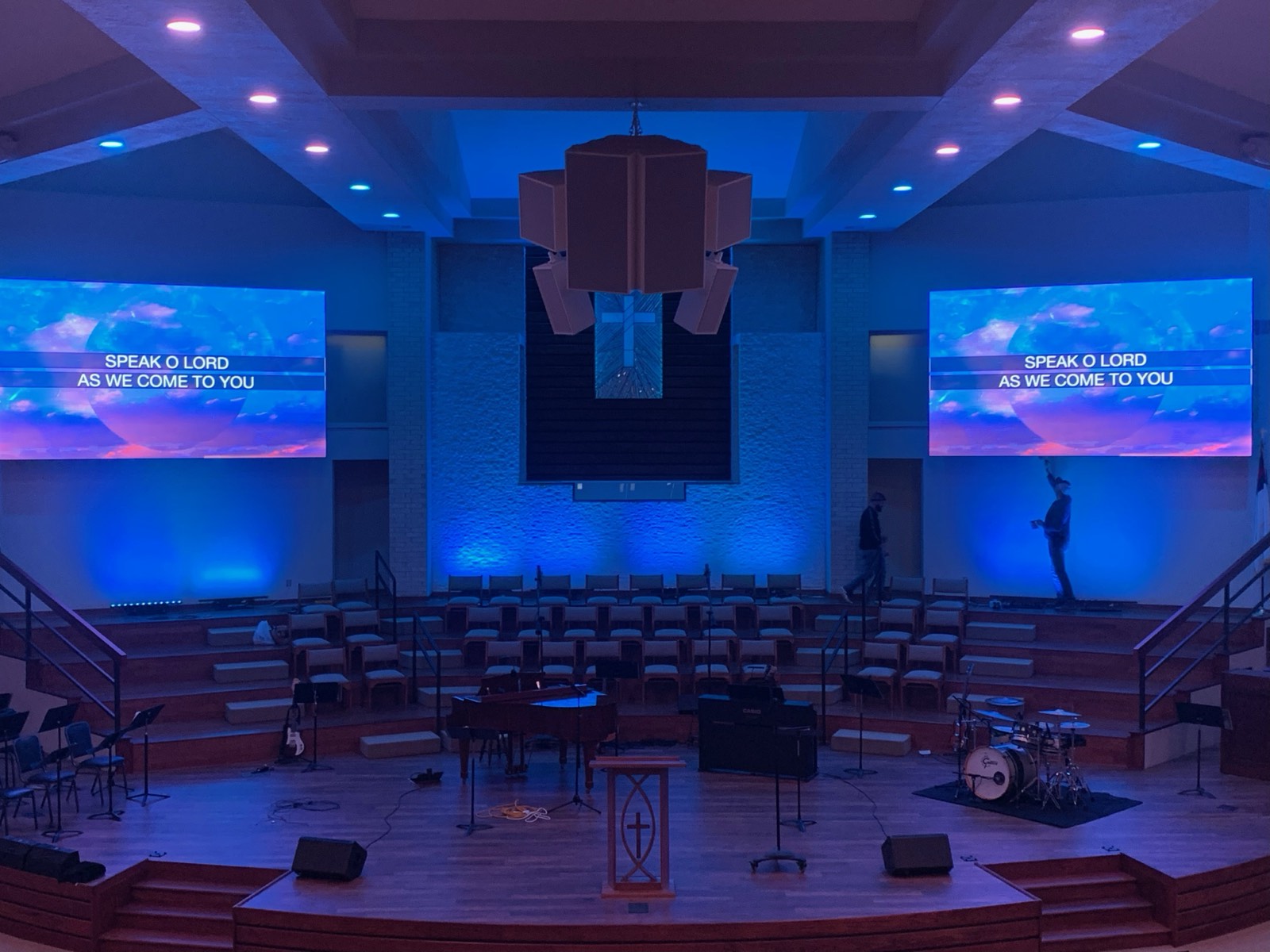
Short answer: choose an LED wall when your room has significant ambient light, you want punchy contrast for lyrics and camera feeds, and you can invest more upfront for lower maintenance. Choose a projector when the room can be kept dim, the budget is tighter, or you need a very large image for the money.
This is the most common video question churches ask us, and the honest answer is that both technologies earn their place. We install both. Here's how we walk churches through the decision.
LED wall vs. projector at a glance
| Factor | LED wall | Projector + screen |
|---|---|---|
| Brightness in a lit room | Excellent. Readable even with windows and house lights up | Struggles. Needs controlled lighting to look its best |
| Contrast and color | Deep blacks, vivid color, great on camera | Good in a dark room, washed out in a bright one |
| Upfront cost | Higher per square foot | Lower. Large images are affordable |
| Cost over ten years | Usually lower maintenance, gradual degradation | Lamps, filters, and eventual brightness loss (laser models improve this) |
| Sightlines and depth | Slim panels mount close to the wall | Needs throw distance or mirror rigs, screens can shadow |
| Serviceability | Individual panels and modules replaceable | Whole-unit service, simpler technology |
| Best in | Bright, contemporary rooms; IMAG and broadcast | Dim or traditional rooms; budget-conscious large images |
When a projector is the right call
Projection has been the church standard for decades for a reason, and it still wins in three situations:
- Your room can go dark. If you control the lighting during services, modern projectors (especially laser models) produce beautiful images without the LED price tag.
- You need maximum image size per dollar. A very large projected image costs a fraction of the equivalent LED square footage.
- The room is architecturally traditional. A screen that retracts, or a discreetly placed projected image, can respect a historic sanctuary in a way a permanent LED wall can't. We think about this a lot; our featured install at Frontline Church is a historic room where every visual decision had to earn its place.
When an LED wall is the right call
- Ambient light is beating your projector. If your congregation squints at washed-out lyrics on sunny mornings, no brighter projector bulb will fix what an LED wall fixes by nature.
- You run cameras. LED's contrast and refresh behavior make it the stronger backdrop for IMAG and livestream, which is why broadcast-oriented churches have moved to it almost universally.
- You're tired of maintenance. No lamps, no filters, and if a section fails, individual modules can be replaced without scrapping the display.
- Stage design is part of your worship language. LED can be built into set pieces, columns, and backdrops, like the twin walls we installed at Chisholm Heights Baptist in Mustang, pictured above.
The honest third option: don't decide alone
The right answer depends on measurements: your room's ambient light, viewing distances, ceiling structure, electrical capacity, and how your services actually run. A good integrator will model your seating layout, calculate the pixel pitch or projection brightness your room genuinely needs, and price both paths so you're comparing real numbers instead of brochure claims. That design work is exactly what we do, and the video decision often affects the audio and lighting scope too, so it pays to plan them together. If sound is also on your list this budget year, start with our guide to church sound system costs.
Frequently asked questions
Is an LED wall worth it for a small church?
Sometimes. In a bright multi-use room, a modest LED wall can outperform projection at a similar all-in cost. In a dim, traditional sanctuary, a good projector usually delivers more image for less money.
How long do LED walls and projectors last?
LED panels are typically rated for tens of thousands of hours and dim gradually. Projectors need lamp and filter care (laser models less so) and lose brightness sooner. Over a decade, LED usually wins on maintenance; projection wins on upfront cost.
What pixel pitch do we need?
It's set by your closest viewer. The nearer the front row, the finer the pitch required for a smooth image. We calculate it from your actual seating chart during design.